19. My Life as a Tautology
1961 Was a Year

This is an ongoing story, meant to be read in order. If you’re just arriving here for the first time, please start at the beginning by following the index.
Part 2
After a four-year hiatus, I’m getting back to my musical memoir, Blues, Preludes & Feuds. A quick summary of what’s transpired up to now...
In the Prelude, I introduced my fictional mentor, the avant-garde bluesman called the Mountain, arguing with him about music and what it means to find your voice. In Part One, we followed my childhood through the neighborhoods of Chicago — the borders I couldn’t cross, the friends who scattered when we moved, the piano landing in the basement, and the slow realization that music was the only thing that made sense. (Several decades later, it’s still the only thing that makes sense.)
Now, in Part Two, I’m older. Adolescence. And the question isn’t where I belong anymore — it’s what I’m going to play.
Stay tuned for weekly chapters from Part 2.
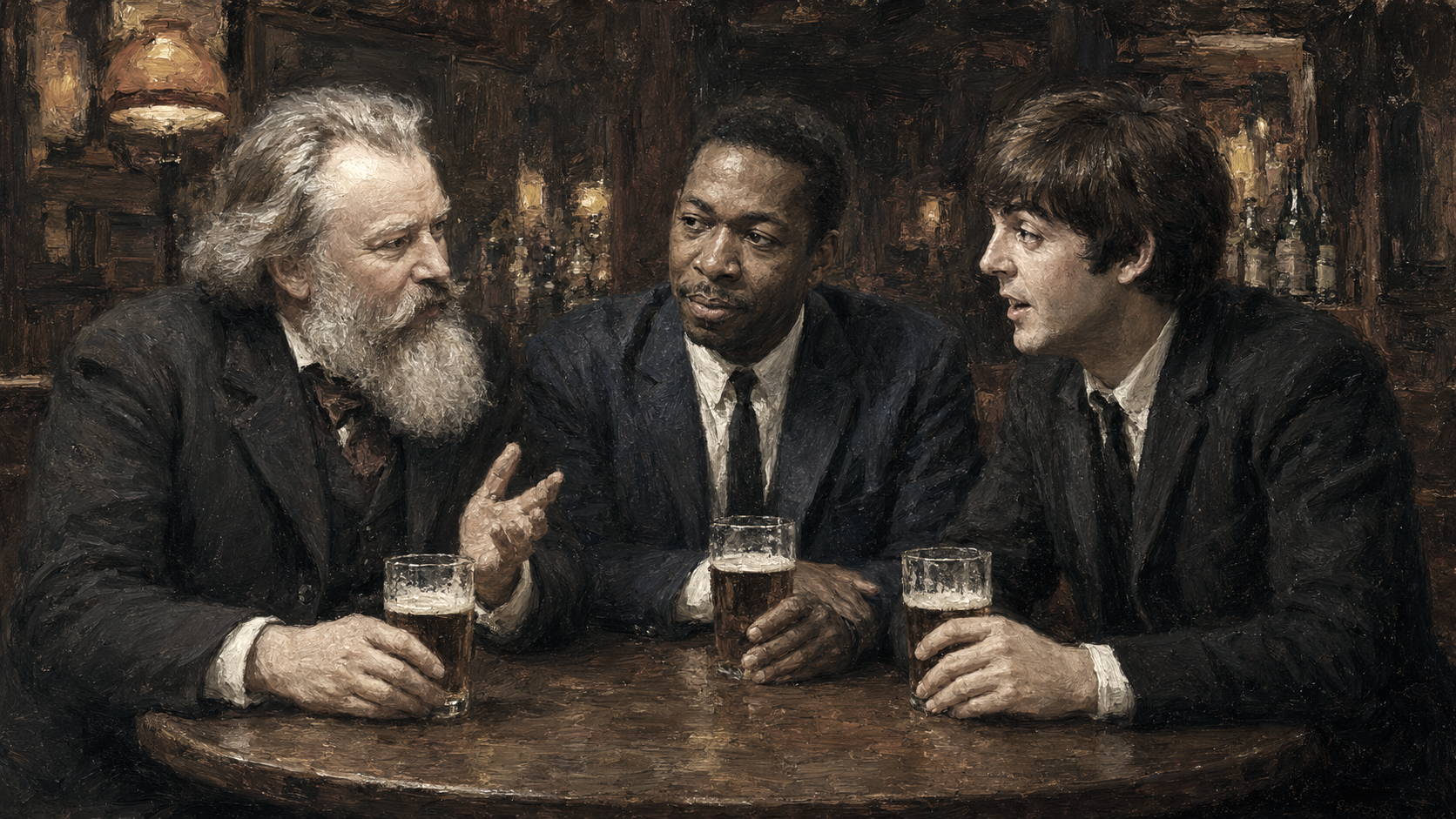
On April 4, 1961, Johannes Brahms had been dead for 64 years and a day. Brahms knew he was the end of a line—his late music carries an aura of swan-song regret. The tradition he built on—Beethoven, Mozart, Haydn, Bach—was already buckling under its own history, collapsing under the weight of too much greatness. That crumbling tradition, long dead by the time I came along, still found its way into my music. Whether I wanted it or not, I was carrying a ghost.
In early ‘61, John Coltrane was leaving bebop behind. In smoky clubs, a simple motif would stretch and twist into something vast, unscripted, almost holy. Having mastered the ultimate harmonic puzzle with tunes like Giant Steps, he wasn’t chasing chord changes anymore; he was chasing something bigger, out past the edges of the known world. Somewhere along the way, he seemed to become lost in the cosmic void. I didn’t know who Coltrane was when he died in ‘67, but by the time I found him, around ‘75, it felt like I’d always known him—a missing piece to a puzzle I didn’t know I was putting together.
The Beatles? In ‘61, they were just a sweaty rumor, pounding out Chuck Berry covers in Hamburg bars, John getting into the occasional fight, Paul trying to protect him. The world didn’t know their names yet, but the fuse was burning. By the time I knew them, they’d already turned pop into high art. I obsessed over their records, worried when rumors surfaced that Paul was dead. Like Beethoven, Bach, Brahms, Coltrane, Miles… they set an impossible standard, the result of absurd talent mixed with ruthless ambition. And yet…
By the time I hit my first creative awakening around 1976, the three traditions that shaped me—classical, jazz, and pop—were already in some kind of collapse. Classical music was culturally irrelevant (except maybe minimalism, which was just irrelevant to me). Jazz was adrift after Coltrane (almost all active jazz musicians will disagree, but the point is, for me, jazz was going nowhere), and pop was shedding its golden-age sheen. Sure, hip-hop and grunge would come along and shake things up, but I was already too late to be part of those worlds, even if I’d come to use elements of both.
I was born both too late and too early for my own good.
And yet I was born at exactly the right time to do what I’m doing. Or maybe I’m doing what I’m doing because I was born exactly when I was born.
And what exactly am I doing?
Three tracks for this chapter, beginning with gorgeous improvisation on a tune just about everyone has heard if they were ever an infant, a parent, or both: Brahms’ Lullaby.
And then a wild, free, but highly thematic improv (with added bass and drums) called Trane Wreck. (You decide what that title means, if anything.) What I will say is that this track exhibits one of the most important features of my mature improvisational style: Everything is theme: the melody, the accompaniment, the chords; everything derived from the opening statement in the left-hand chords. Brahms, by the way, was a master of this idea: make everything thematic.
And finally, a short, poignant improvisation called Elegy for Three, for the death of, I suppose, the three great traditions that gave me musical life.